Example of things to look for when preparing an objection:
“In valuing the land, our valuers consider a number of factors, including:
- the current market, including trends and recent sales
- size, shape and elevation
- accessibility to the land
- risk or impact of adverse natural events, such as flooding or erosion
- town planning restrictions
- vegetation protection orders.”
Try to base your objection on one of the above points.
The main tool I use is the Queensland Government Find your land valuation tool.
Find your land valuation | Environment, land and water | Queensland Government
You need to look at your property in relation to others in the area. Enter your address and it will display your value. If your valuation seems high list the reasons why to provide the basis for your objection. You will also need to say how much you think your property should be. It will also display a map (see below) with neighbouring properties pinned (blue pin), your value compared to median values and samples of recent residential land sales (you can also get this from real estate sites but must be before 1 October 2025). If you click on a blue pin it will display the new value for that property and show a link to that property’s details.
Example
In this area the dominant factor for property prices is views of the bay. Proximity to the bay is almost cancelled out by sandflies. Comparing Lots 286 ($1,250,000 688 sq m) and 288 ($1,300,000 1040sq m) on Queens Esplanade shows the two lots have similar characteristics, one has 33% less area than the other (mainly due to width of the block) but the value is only 4% less (1% per 8% of area difference). This indicates area and shape do not significantly influence price in this area where view is the dominant feature.
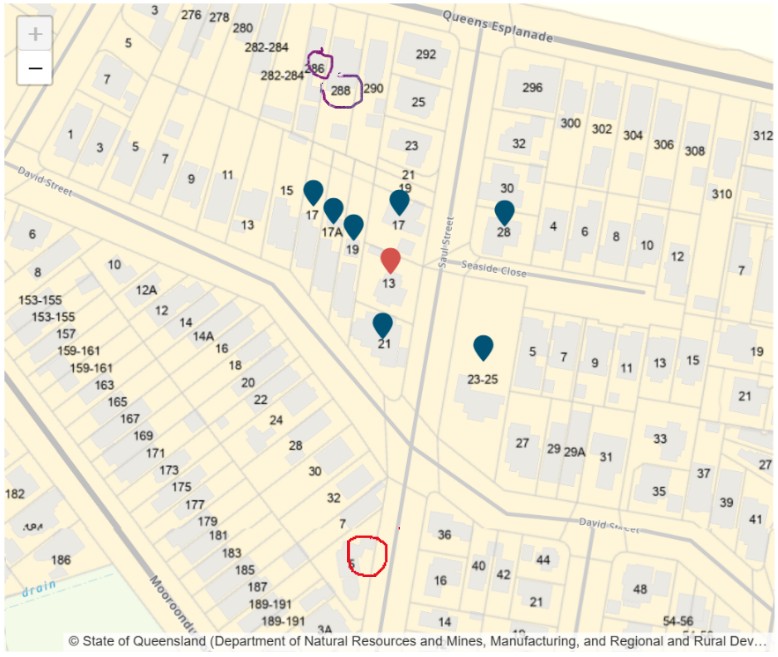
Lots 17, 17a and 19 in David St. are all similar. All have great bay views from the house but not from standing on the land. All are built over a slippage zone. They should have approximately the same values, but 17 is $780,000 (708sq m), 17a is $830,000 (790 sq m) and 19 is $860,000 (872 sq m). 17a and 19 could object on the basis that their land is not worth that much more than 17 as the area of land along the ridge is about the same for each block and the area in the backyard of each is low and little used. Suggested values for 17a and 19 could be $792,000 and $803,000 respectively. ($780000+1.5% and 3% for area difference (1% price per 8% area)).
Lots 5, 7, 9, 11, 13 and 15 in David St. could all object on the basis that their areas and land aspects are all similar to 19, but at the rate per sq m ($986) for 19 their values would be about $900,000. The wider frontage should have little impact as indicated by analysis of lots 286 and 288 above.
Lot 13 in Saul St ($960,000 805 sq m) is adjacent to Lot 19 but not on the ridge that David St follows. Its value is heavily influenced by its neighbours with bay views but it has no view over the bay from any part of the land. It compares with Lot 5 (857 sq m) in area but Lot 5 is higher and more level than 13. Also 13 is partially covered by a slippage zone and storm surge zone. The value of lot 13 on Saul St should be less than Lot 5 ($730,000).
At a previous objection meeting at lot 19 David St. a valuer from the Valuer General’s Department explained that lot 19 did not have a view because we could not see the bay from any part of the land (there were no improvements at that time). All houses in this area are 2 storey to capture the views and their market price reflects the view. Apparently when the value of improvements is subtracted from a sale price to get the land price, the value of the view is transferred to the land because it is not part of the improvement. It is enabled by the improvement but should be included in the value of improvements, not the unimproved land valuation. I believe there are three components to a land price – land, improvements and a premium that buyers are prepared to pay above a reasonable price for a particular feature or because of a challenging market. This premium should be identified and removed from the land valuation, but it is currently ignored.
Sometimes it may be necessary to work out the land value from the sale of an improved property. Insurance companies and real estate web sites generally have sales data or calculators that can help to estimate the cost of the infrastructure.
As you can see there are huge discrepancies in land valuations. These have had a compounding effect for over 50 years, destroying the great Australian dream for young Australians and the Australian economy which is now centred on housing.